War Changes Everything: US Attack on Iran Plunges FIFA World Cup 2026 Into Unprecedented Crisis
With the United States now at war with Iran, FIFA faces a situation no football governing body has ever confronted — a host nation in active military conflict with a qualified participant
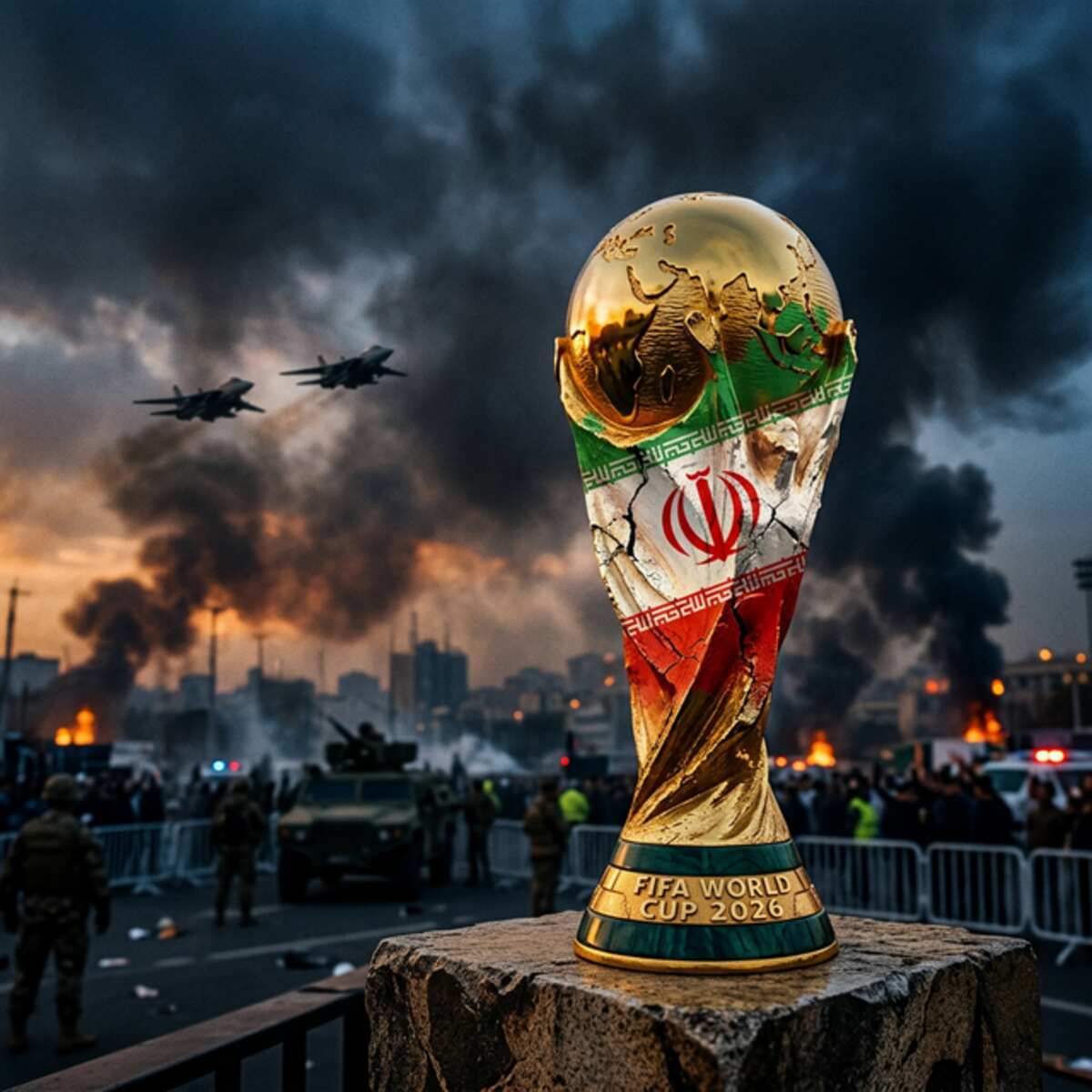
In three months, the 2026 FIFA World Cup kicks off on American soil. As of this week, the United States is at war with one of the 47 nations scheduled to play in it.
The US-Israeli military campaign against Iran — launched on 28 February 2026 — has sent shockwaves beyond the Persian Gulf and into the offices of football's most powerful governing body. FIFA, the organisation that prides itself on sitting above politics, is now navigating something it has never faced before: a World Cup host nation in active military conflict with a qualified competing nation.
The drama is playing out on multiple fronts simultaneously — on the battlefield, in the halls of FIFA, in Washington, and inside the hearts of Iranian players scattered across Europe who earned their World Cup place fair and square.
🚨 The Military Campaign That Changed Everything
The strikes began on Saturday, 28 February 2026. Operation Roaring Lion — the Israeli component — and Operation Epic Fury — the American campaign — targeted Iranian military infrastructure, leadership bunkers, and nuclear facilities in coordinated waves.
Reports from multiple intelligence and media sources indicate that Iran's Supreme Leader Ali Khamenei was killed in the strikes — a development that, if confirmed, would represent one of the most consequential events in Middle Eastern geopolitics in decades.
Iran has responded with retaliatory missile and drone strikes against Israeli cities, US military bases in the region, and multiple Gulf states including Saudi Arabia, the UAE, Qatar, and Kuwait. The Strait of Hormuz, through which roughly 20% of global oil passes, has been effectively closed to commercial shipping, sending oil prices soaring.
This is not a diplomatic spat. This is not sanctions. This is open war — and it began precisely 100 days before Iran's footballers were due to run out onto SoFi Stadium in Los Angeles.
⚽ FIFA Scrambles: The Wales Moment
When the missiles flew on Saturday, FIFA's senior officials were gathered in Zurich's shadow — actually in Wales, for what would ordinarily have been a routine annual meeting to discuss the game's rules. Instead, the conversation pivoted entirely.
FIFA Secretary General Mattias Grafström confirmed in a news conference that the organisation was "closely monitoring the situation," while insisting its priority was a safe tournament with all 48 nations participating. He stopped short of saying Iran's place was in jeopardy — a careful, diplomatic non-answer that revealed exactly how unprecedented the situation is.
"We are closely monitoring the situation in Iran. Our priority remains a safe World Cup with all qualified teams participating, but we are prepared for all scenarios." — Mattias Grafström, FIFA Secretary General
FIFA officials were simultaneously examining contingency options: replacing Iran with another team, restructuring Group G as a three-team group, or potentially relocating Iran's matches from US venues to neutral territory in Canada or Mexico.
🤐 Infantino's Impossible Silence
The most glaring absence in FIFA's public response is that of its president, Gianni Infantino.
As of publication, Infantino has not commented on the conflict at all. The silence is politically deafening — and the reason is not hard to identify.
In December 2025, at the FIFA World Cup Draw in Washington D.C., Infantino stood beside President Donald Trump and presented him with the inaugural FIFA Peace Prize. It was a moment of extraordinary optics — one that tied the football supremo intimately to the administration that has now launched a military campaign against a World Cup participant.
Criticising the US military action would embarrass Trump. Staying silent abandons Iranian football. Infantino is trapped between the two most politically charged relationships of his presidency, and he has — for now — chosen silence.
😶 Trump: "I Don't Care"
When asked by Politico on Monday whether he wanted Iran to participate in the World Cup he helped bring to American shores, President Trump's response was characteristically blunt:
"I don't care."
Three words that encapsulate the depth of the political minefield FIFA is now operating in.
Trump, who has championed the US hosting of the 2026 World Cup as a personal legacy project, appears entirely unmoved by the tournament implications of the military campaign. Whether the US State Department will honour the FIFA Host Country Agreement — which guarantees visa access to all qualified nations — under active war conditions is now the central legal and diplomatic question facing the sport.
🇮🇷 The Iranian Football Federation: Pessimism, Publicly
The first senior football figure to break the silence from the Iranian side was Mehdi Taj, president of the Football Federation Islamic Republic of Iran (FFIRI).
In comments that mark the most explicit signal yet that participation may not happen, Taj expressed pessimism about Iran's ability to travel and compete given the military situation. He cited the dual challenge of visa access — already a fraught issue after Iranian federation officials were denied entry to the FIFA Draw in November 2025 — and the personal safety of players, many of whom have family members still inside Iran.
The statement stops short of a formal withdrawal. But its tone is unmistakeable.
📍 The Logistical Nightmare: Why Iran Can't Just Play Elsewhere
Iran was drawn into Group G and is scheduled to play all three of its group-stage matches on American soil:
| Match | Venue | Date |
|---|---|---|
| 🇮🇷 Iran vs 🇳🇿 New Zealand | SoFi Stadium, Los Angeles | June 16, 2026 |
| 🇮🇷 Iran vs 🇧🇪 Belgium | SoFi Stadium, Los Angeles | TBC |
| 🇮🇷 Iran vs 🇪🇬 Egypt | Lumen Field, Seattle | TBC |
There is no rescheduling fix that simply moves matches to Canada or Mexico — at least not without monumental logistical, legal, and commercial upheaval. Ticket holders, broadcasters, stadium operators, and local authorities in Los Angeles and Seattle are all contracted partners in a framework built years in advance.
And even if the games were moved, Iran's players — scattered across European clubs including Inter Milan (Taremi) and Bayer Leverkusen (Azmoun) — would still need to physically travel, coordinate with their squads, and pass through immigration checks, some of which involve military or intelligence screening of individuals from Iran.
🌍 Europe's Growing Discomfort: Boycott Talk Emerges
The conflict is not only threatening Iran's participation. It is prompting broader questions across Europe about the tournament itself.
Discussions are emerging in several European football circles about a potential boycott of the 2026 World Cup — not from nations politically allied with Iran, but from those opposed to the US military campaign more broadly. These conversations remain at an early, informal stage, but their very existence marks a significant escalation of the sport's politicisation ahead of June's tournament.
No European federation has made any formal statement. But the talk exists, and FIFA will be aware of it.
🔄 FIFA's Contingency Options
FIFA's regulations are clear on replacement procedures, and the organisation has been here before — most recently when Russia was expelled following the invasion of Ukraine ahead of Qatar 2022.
If Iran withdraws or is unable to participate, the replacement hierarchy is:
- Highest-ranked available AFC team that did not qualify — most likely the United Arab Emirates or Iraq
- If no AFC team is available, the highest globally ranked non-qualifier steps in
- As a last resort, Group G proceeds as a three-team group: Belgium, Egypt, and New Zealand play two games each
The critical deadline is Iran's formal squad submission in May 2026. That is the last practical moment at which a replacement team could be integrated into tournament preparations with any credibility.
💔 What This Means for the Game's Greatest Romantics
Millions of Iranian-Americans — particularly in Los Angeles, home to one of the world's largest Iranian diaspora communities — had been among the most anticipated fan groups of the entire tournament. The prospect of watching Iran play in their adopted city was, for many, a once-in-a-generation emotional event.
For Sardar Azmoun and Mehdi Taremi — the stars who powered Iran through AFC qualifying and through back-to-back World Cups — this may be their last realistic chance to compete at football's grandest stage. They did everything right. They qualified. They were drawn. They prepared.
The decision to go to war is not theirs. The consequences, however, fall squarely on them.
Iran National Team Squad for 2026 World Cup Qualifiers | Update March 2025
📅 The Timeline That Now Defines Everything
| Date | Event |
|---|---|
| 28 February 2026 | US-Israeli military strikes against Iran begin |
| 1 March 2026 | FIFA confirms it is monitoring situation; contingencies examined |
| March 2026 | Inter-confederation play-offs — replacement team window opens |
| May 2026 | Final squad submission deadline — last chance for Iran to confirm |
| 16 June 2026 | Iran's scheduled Group G opener vs New Zealand, Los Angeles |
The window to resolve this is not months — it is weeks. Every day of continued military conflict narrows the realistic options available to FIFA, to Iran, and to the thousands of people whose World Cup plans now hang in the balance.
🎯 The Bottom Line
FIFA is facing the situation it hoped it would never have to face. The governing body has protocols, contingencies, and precedents — Russia 2022 proved that. But none of those precedents involved a host nation at war with a participant.
The Iranian football team did not start this war. They qualified through skill, organisation, and determination. They deserve to be at this World Cup by every measure the sport recognises.
Whether football's values — and FIFA's Host Country Agreement — are strong enough to withstand the geopolitical storm now engulfing the Persian Gulf is a question that the next few weeks will answer.
Follow all the latest updates: Full 2026 World Cup Match Schedule · Iran & the 2026 World Cup: The Full Contingency Plan · All 16 Host Cities Guide · Ticket Guide
Sources: The New York Times (Tariq Panja, March 4 2026), Politico, FIFA.com, IISS, Republic World, Jerusalem Post