Cabo Verde at the FIFA World Cup 2026: The Blue Sharks Are Coming
From an archipelago of half a million souls to the world's biggest stage — Cabo Verde's historic World Cup debut is the most extraordinary qualification story of 2026.

There is a category of sporting story that transcends results, rankings and tactics. A story that reminds you why sport exists in the first place — why billions of people across the planet stop whatever they are doing when a whistle blows and a ball starts rolling.
Cabo Verde qualifying for the 2026 FIFA World Cup is one of those stories.
An archipelago of ten volcanic islands in the central Atlantic Ocean. A population of just over 500,000 people — fewer than the attendance at a handful of Premier League home games combined. A national football federation that only affiliated with FIFA in 2001. And yet, on October 13, 2025, the Blue Sharks — Tubarões Azuis — sealed their place in North America by topping CAF Group D above Cameroon, one of African football's most storied nations.
The Cabo Verde FIFA World Cup 2026 adventure is not just a football story. It is among the most remarkable tales of grit, diaspora, ambition and collective belief that global sport has produced in years. The 48-team expansion opened a door — and Cabo Verde walked through it with intent, class and a record that left no room for argument.
🌍 Team Overview
| Detail | Information |
|---|---|
| Country | Cabo Verde (Cape Verde) |
| Nickname | Tubarões Azuis (Blue Sharks) |
| Confederation | CAF (Confederation of African Football) |
| FIFA Ranking | ~50th (2025) |
| Population | ~500,000 |
| World Cup Appearances | 1 (2026 — debut) |
| AFCON Best Result | Quarter-finals (2013, 2023) |
| Head Coach | Pedro "Bubista" Leitão Brito |
| Home Kit | Blue |
| Captain | Ryan Mendes |
Second only to Iceland as the least populous nation ever to qualify for the World Cup, Cabo Verde's very presence in North America in 2026 is already a historic achievement that will be cited for decades.
🛣️ Road to the World Cup: How the Blue Sharks Got There
The path to the Cabo Verde FIFA World Cup 2026 qualification ran through CAF Group D — a demanding pool that featured Cameroon, Angola, Libya, Eswatini and Mauritius. On paper, Cabo Verde were not the favourite to win it. In practice, they were simply the best team.
CAF Group D Final Standings
| Team | P | W | D | L | GF | GA | Pts |
|---|---|---|---|---|---|---|---|
| 🇨🇻 Cabo Verde | 10 | 7 | 2 | 1 | — | — | 23 |
| 🇨🇲 Cameroon | 10 | — | — | — | — | — | 19 |
| 🇦🇴 Angola | 10 | — | — | — | — | — | — |
Cabo Verde won seven of their ten qualifier games and drew two, finishing four points clear of Cameroon at the summit. Their defensive record was exceptional — seven clean sheets across the campaign — underpinning a collective resilience that has become coach Bubista's hallmark.
Key Qualifying Moments
- 3-0 vs Eswatini — The result that clinched qualification. A dominant home display that sent the island nation into raptures, with streets across Praia filling with dancers, drummers and fireworks.
- 4-1 defeat to Cameroon — The solitary blot on the campaign, which Cabo Verde absorbed and then responded to magnificently, winning all remaining fixtures.
- 3-3 draw with Libya — A demonstration of Cabo Verde's attacking threat and competitive character under pressure.
Leading qualifiers scorers: Dailon Livramento (4 goals), Willy Semedo (2 goals), Stopira (1 goal).
👟 Squad & Key Players
Cabo Verde's unique strength lies in its diaspora model. With significant Cabo Verdean communities in Portugal, the Netherlands, France, Luxembourg and the United States, the national team draws on a talent pool spread across some of Europe's top leagues — a diaspora-powered squad that punches well above its geographic weight.
The Five Players Who Could Define Cabo Verde's World Cup
1. Ryan Mendes — Captain | Winger | Club: Various (Europe) The heartbeat and captain of the Blue Sharks. Cabo Verde's all-time leading scorer and most-capped player, Mendes brings leadership, experience and relentless quality on the ball. At 35, the World Cup will be the crowning chapter of a remarkable international career.
2. Vozinha — Goalkeeper | Veteran Shot-Stopper A commanding, experienced goalkeeper who has been the cornerstone of Cabo Verde's defensive resolve for years. His seven clean sheets in qualifying tell their own story. If the Blue Sharks are to upset anyone in North America, Vozinha will be central to it.
3. Logan Costa — Defender | Centre-Back | Club: Toulouse (France) One of Cabo Verde's most technically accomplished defenders, Costa plays at the highest level of French football and brings composure and reading of the game that will be essential against Spain, Uruguay and Saudi Arabia. A key figure in Bubista's back line.
4. Dailon Livramento — Forward | Top qualifier scorer The sharpest cutting edge in Cabo Verde's attacking play, Livramento led the team's goal tally in qualifying with four strikes. Quick, clinical and clever in tight spaces, his ability to create chances from nothing makes him the most dangerous Blue Shark in the opponent's final third.
5. Jamiro Monteiro — Midfielder | Creative Spark Cabo Verde's engine and creative force in midfield. Monteiro's ability to pick up the ball, drive at defences and distribute with precision provides the link between the Blue Sharks' solid defensive base and their dangerous forwards. Against top opposition, keeping Monteiro fit and functional is non-negotiable.
👨💼 Head Coach: Pedro "Bubista" Leitão Brito
Nationality: Cabo Verdean
Award: 2025 CAF Men's Coach of the Year
Style: Organised, defensively compact, transitions-focused
If there is one individual whose name will be forever associated with the Cabo Verde FIFA World Cup 2026 story, it is Bubista.
Named the CAF Men's Coach of the Year for 2025 — the highest individual coaching honour on the African continent — Bubista has transformed the Blue Sharks from perennial overachievers into genuine, methodical contenders. His approach is rooted in defensive organisation first: he demands tactical discipline from his backline, builds from a position of solidity, and then unleashes his dynamic midfielders and forwards on the counter.
What makes Bubista truly special is his ability to forge a unified identity from a squad drawn from clubs across half a dozen countries and three continents. He has created a genuine team spirit — a rarest commodity in international football — and harnessed the diaspora's pride in a way that turns "wearing the shirt" into something visceral and motivating far beyond the professional obligation.
His two AFCON quarter-final campaigns — 2013 and 2023 — demonstrated that he can compete and thrive against elite African opposition in tournament football. The World Cup is his ultimate stage.
⚽ Playing Style & Formation
Preferred Formation: 4-3-3 (transitioning to 4-5-1 out of possession)
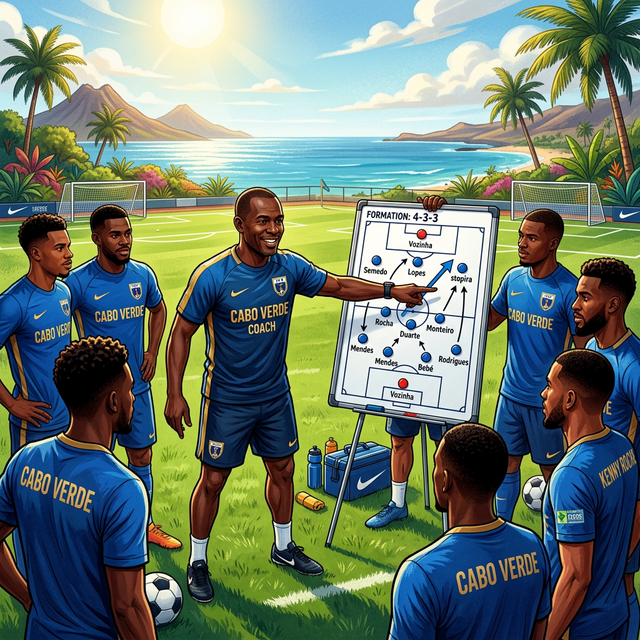
Cabo Verde under Bubista are built on a low defensive block, rapid transitions and clinical execution in the final third. The team does not attempt to dominate possession — instead, they invite pressure, absorb it with discipline, and then hit opponents on the break with pace and directness.
Attacking Strengths:
- Explosive wingers who thrive in wide areas and in behind defence
- Lethal on set pieces — a crucial weapon against physically superior opponents
- Counter-attacking precision born from thousands of hours of collective drilling
Defensive Strengths:
- Among the best-organised defensive units in African football
- Goalkeeper and centre-backs exceptionally solid under pressure
- High defensive IQ — players understand their roles without the ball
This is a team that does not need to be the better side for 90 minutes. It needs to be better at the moments that matter — and under Bubista, they routinely are.
📖 World Cup History
| Category | Detail |
|---|---|
| First World Cup | USA/Canada/Mexico 2026 (Debut) |
| Total Appearances | 1 |
| Best Result | TBC |
| AFCON Appearances | 4 (2013, 2015, 2021, 2023) |
| AFCON Best Result | Quarter-finals (2013, 2023) |
There is no World Cup history for Cabo Verde — because 2026 is where their history begins.
But the Blue Sharks are not arriving on the global stage without credentials. They have competed at four Africa Cup of Nations tournaments, reaching the quarter-finals in both 2013 and 2023 — a performance level that places them comfortably in the upper tier of African football despite their tiny size.
At AFCON 2013, on their debut, they stunned continent and caused instant upsets en route to the last eight. A decade later at AFCON 2023, they did it again. This is a team that has proven, repeatedly, that it knows how to perform when the stakes are highest.
The 2026 World Cup is not Cabo Verde arriving on a lucky ticket. It is the natural continuation of a journey that has been building for over a decade.
🏟️ Group Stage Draw — Group H
Cabo Verde were placed in Group H — a group containing two former World Cup winners and one team from the Asian confederation. Here is the full picture:
| Team | Confederation | World Cup Wins |
|---|---|---|
| 🇪🇸 Spain | UEFA | 1 (2010) |
| 🇺🇾 Uruguay | CONMEBOL | 2 (1930, 1950) |
| 🇨🇻 Cabo Verde | CAF | 0 (Debut) |
| 🇸🇦 Saudi Arabia | AFC | 0 |
Match Schedule
| Date | Match | Venue |
|---|---|---|
| June 15, 2026 | 🇪🇸 Spain vs 🇨🇻 Cabo Verde | Atlanta Stadium, Atlanta |
| June 21, 2026 | 🇺🇾 Uruguay vs 🇨🇻 Cabo Verde | Miami Stadium, Miami |
| June 26, 2026 | 🇨🇻 Cabo Verde vs 🇸🇦 Saudi Arabia | Houston Stadium, Houston |
Spain and Uruguay are generational super-powers. The game against Saudi Arabia — whose own AFCON-conquering moment at Russia 2022 against Argentina is now World Cup folklore — is the group's decisive fixture for Cabo Verde. Win that match, and anything is possible.
⚖️ Strengths & Weaknesses
✅ Three Strengths
1. Defensive Discipline Seven clean sheets in qualifying is not a coincidence — it is the product of Bubista's meticulous defensive organisation. Against elite opposition, a well-drilled defence is the Blue Sharks' greatest asset.
2. Tournament DNA Two AFCON quarter-final appearances show this is a team that elevates its game on the biggest stages. They do not shrink — they grow. That psychological quality is priceless in a World Cup group stage.
3. Diaspora Depth and Unity A squad drawn from clubs across Europe brings tactical versatility and a hunger to represent something greater than themselves. The Blue Sharks play for every Cabo Verdean scattered across the globe — and that emotional fuel is a real competitive advantage.
❌ Three Weaknesses
1. Lack of World Cup Experience No World Cup experience whatsoever. How players respond to the atmosphere, pressure and intensity of football's biggest stage — particularly against Spain in Game 1 — is genuinely unknown.
2. Limited Squad Depth With most players operating below the absolute elite club level, a key injury — particularly to Vozinha, Logan Costa or Mendes — could significantly impact the team's ceiling.
3. The Toughest Possible Group Spain and Uruguay are not merely difficult opponents — they are among the most experienced tournament sides in football history. Navigating their tactical quality without conceding too many goals in the first two games will require near-perfect execution.
🔮 Tournament Prediction: Realistic Expectations
Realistic outcome: Group stage exit with heads held high — and possibly a historic result along the way.
The honest prediction for the Cabo Verde FIFA World Cup 2026 campaign is a group-stage exit. Spain and Uruguay are simply among the finest sides on the planet, with decades of World Cup-winning experience behind them. The margin between Cabo Verde's ceiling and those opponents' floors is still significant.
But football does not always follow the script.
Saudi Arabia — who themselves shocked Argentina at Qatar 2022 — offer a genuine, winnable game. And if Cabo Verde can keep Spain or Uruguay competitive into the final quarter of one of those matches, the potential for an upset against the odds exists.
The fairytale scenario: Beat Saudi Arabia, draw with Uruguay, and find themselves in a position to cause chaos in a Round of 32. It has happened before. It will happen again. Why not the Blue Sharks of the Atlantic?
The realistic scenario: Three competitive, committed performances; a famous goal or two; a result that shakes at least one opponent; and an exit with the dignity and reputation of a nation that showed the world what its football is capable of.
Either way — the Cabo Verde FIFA World Cup 2026 story is already one of the tournament's greatest narratives.
🎉 Fan & Football Culture: The Blue Sharks' Nation
Football in Cabo Verde is not just a sport. It is the fabric of island life — woven into every community across Santiago, São Vicente, Santo Antão and the seven other islands that make up this Atlantic archipelago.
The game arrived through Portuguese colonisers in the early 20th century and took instant root. Today, it is the dominant sport, the national conversation-starter and the primary source of collective pride for a country whose geography — scattered across 4,000 square kilometres of open ocean — might otherwise make collective identity difficult.
The announcement of World Cup qualification was met with scenes of pure carnival euphoria: streets in the capital Praia and in Mindelo, the cultural heartbeat of the archipelago, filled with dancers, bands, fireworks and flag-waving that lasted through the night and into the following days. For a nation that has achieved so much with so little, this was not just a sporting moment — it was a national awakening.
The diaspora dimension adds another layer of emotional depth. Cabo Verdean communities in Portugal, the Netherlands, France, Luxembourg and the United States — communities that have kept the culture of the islands alive across ocean and decades — will arrive at stadiums in Atlanta, Miami and Houston draped in blue, carrying flags, singing in Creole and representing a football nation that the world is only just beginning to discover.
Famous Cabo Verdean football supporters include the communities of Praia, Mindelo, Lisbon and Rotterdam — cities where the Blue Sharks jersey is worn not just on match days, but as a statement of identity and belonging.
📅 Key Dates for Blue Sharks Fans
| Date | Match | Venue |
|---|---|---|
| June 15, 2026 | 🇪🇸 Spain vs 🇨🇻 Cabo Verde | Atlanta |
| June 21, 2026 | 🇺🇾 Uruguay vs 🇨🇻 Cabo Verde | Miami |
| June 26, 2026 | 🇨🇻 Cabo Verde vs 🇸🇦 Saudi Arabia | Houston |
🎯 The Bottom Line
Cabo Verde do not arrive at the FIFA World Cup 2026™ as tournament favourites. They arrive as something far more powerful: a symbol.
A symbol of what football's expanded format can produce. A symbol of what diaspora, ambition and extraordinary coaching can build. A symbol of what happens when 500,000 people on ten volcanic islands decide, collectively, that their country belongs on the world's greatest sporting stage — and then prove it one qualifying win at a time.
Coach Bubista, captain Ryan Mendes, the rock-solid Vozinha between the posts, the clinical Dailon Livramento and a squad united by blood, ocean and the blue shirt — they are coming to North America not as tourists, but as competitors.
The Blue Sharks have made it to the deepest waters. Now they hunt.
Further reading: Spain at the 2026 World Cup · Belgium at the 2026 World Cup · Full 2026 World Cup Match Schedule · All 16 Host Cities Guide
Sources: FIFA.com, CAF Online, The Guardian, Al Jazeera, FourFourTwo, Wikipedia