Austria at the FIFA World Cup: The Complete Team Profile, History & 2026 Preview
From the legendary Wunderteam of the 1930s to a third-place finish in 1954 — and now a first World Cup return in 28 years under Ralf Rangnick
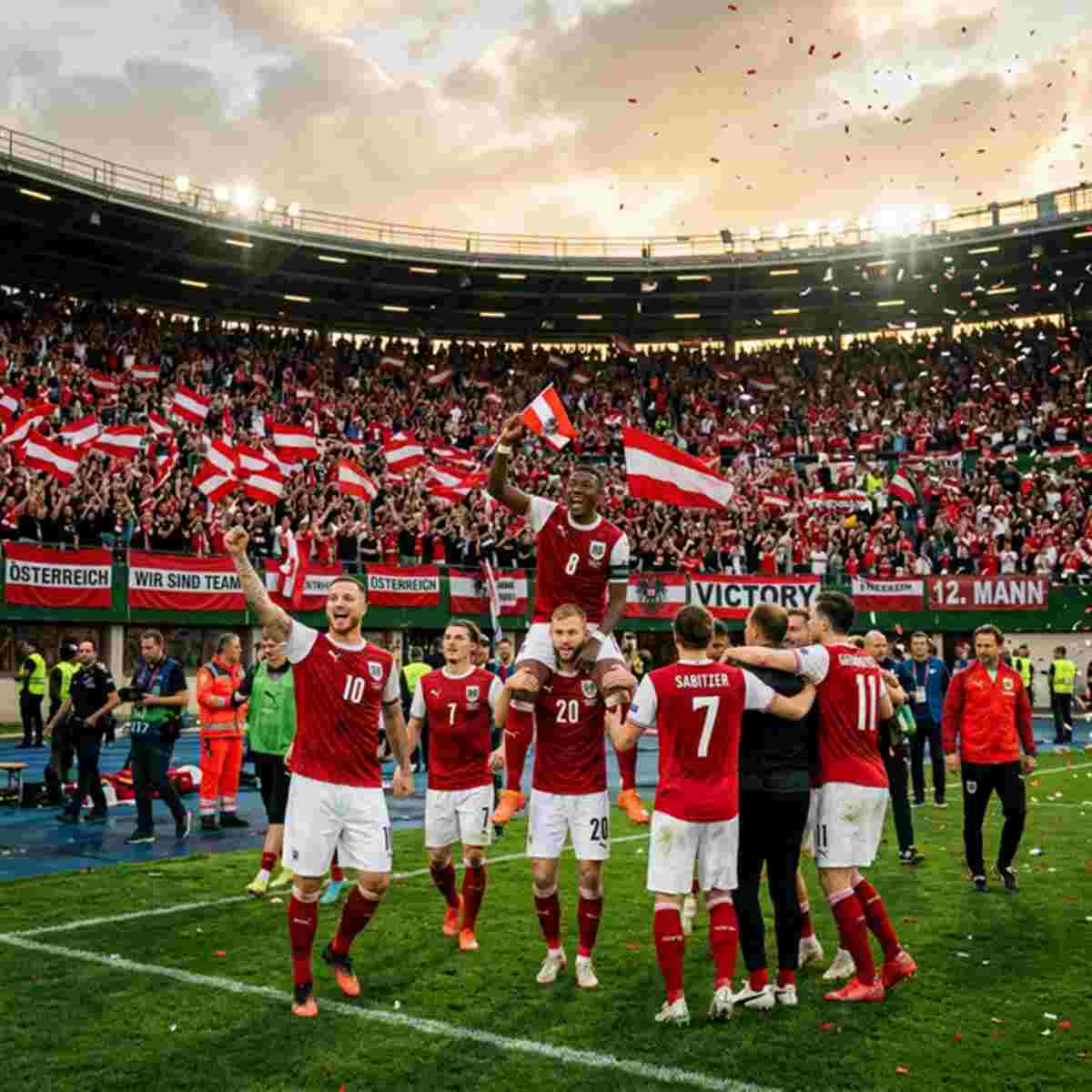
Austria are back. After 28 years of absence from football's grandest stage — the longest drought in the country's modern footballing history — the Nationalmannschaft have earned their place at the 2026 FIFA World Cup in North America.
It is a return that carries enormous weight. Austria were once among Europe's most feared football nations. Their 1930s Wunderteam was considered the best side in the world. Their 1954 campaign produced the highest-scoring match in World Cup history. And yet, for nearly three decades, they watched the World Cup from afar.
Under Ralf Rangnick — one of football's most celebrated coaching minds — Austria are ready to remind the world what they are capable of.
This is the complete guide to Austria at the FIFA World Cup: every tournament, every match, every goal, and everything you need to know about their 2026 campaign.
🇦🇹 Austria at a Glance
| Detail | Information |
|---|---|
| Official Federation | Österreichischer Fußball-Bund (ÖFB) |
| Nickname | Das Nationalteam / The Nationalmannschaft |
| World Cup Appearances | 8 (1934, 1954, 1958, 1978, 1982, 1990, 1998, 2026) |
| Best Result | 3rd Place (1954) |
| Total Matches (historic) | 29 — 12W · 4D · 13L |
| Goals Scored | 43 |
| Goals Conceded | 47 |
| Head Coach (2026) | Ralf Rangnick |
| Captain | David Alaba |
| FIFA Ranking | ~25th (UEFA) |
| Confederation | UEFA |
Note: Austria qualified for the 1938 World Cup but were forced to withdraw after the Anschluss — the annexation of Austria by Nazi Germany. In 1950, Austria registered but later withdrew voluntarily. These appearances are not counted in standard match statistics.
📜 The Story: From Wunderteam to the Longest Wait
The Wunderteam Era (1930s)
Austria's place in football history was cemented long before the World Cup gave it a stage. In the early 1930s, under legendary coach Hugo Meisl, Austria's national team became the envy of Europe. Nicknamed the Wunderteam (Wonder Team), they played a fluid, quick-passing style far ahead of its time — influenced by English coach Jimmy Hogan — and embarked on an extraordinary unbeaten run of 14 consecutive matches between April 1931 and December 1932.
The nucleus of the Wunderteam was Matthias Sindelar — the Paper Man — one of the greatest footballers ever to play the game. Sindelar's slender frame masked his extraordinary technical ability, vision, and football intelligence. He was Austria's answer to any question football could pose.
At the 1934 World Cup in Italy, the Wunderteam reached the semi-finals before losing 1-0 to the hosts in controversial circumstances. They finished fourth — an achievement that barely scratched the surface of what they were capable of.
The 1938 World Cup should have been Austria's moment. They were among the favourites. Then, in March 1938, Germany annexed Austria. The country ceased to exist as an independent nation. Its players were absorbed into the German squad. Some, like Sindelar — who refused to play for the occupiers — found other ways to resist. Sindelar died in January 1939, in circumstances that have never been fully explained.
Austria's football story — and its heartbreak — is inseparable from the darkness of that era.
The 1954 Campaign: The Greatest Performance
The World Cup that defined Austria forever was Switzerland 1954 — and specifically, one extraordinary afternoon in Lausanne.
🏆 Every FIFA World Cup Appearance — Full Results & Stats
🇮🇹 1934 | Italy — Fourth Place ⭐ Historic Achievement
The Wunderteam's only World Cup outing. Austria defeated France 3-2 in the round of 16, then fell to hosts Italy 1-0 in a bruising semi-final that many Austrians still believe was decided by more than football. They defeated Germany 3-2 in the third-place match to finish fourth.
| Round | Opponent | Result |
|---|---|---|
| Round of 16 | 🇫🇷 France | Win 3-2 |
| Semi-final | 🇮🇹 Italy | Loss 0-1 |
| Third-place | 🇩🇪 Germany | Win 3-2 |
🇨🇭 1954 | Switzerland — Third Place 🥉 Best-Ever Result
Austria's finest hour in international football. Their campaign included multiple big wins and culminated in a third-place finish — the best result Austria has ever achieved at a World Cup.
The historic quarter-final against Switzerland on 26 June 1954, at La Pontaise, Lausanne, is the match that every football historian knows. Played in searing 40°C (104°F) heat — the Hitzeschlacht von Lausanne (The Heat Battle of Lausanne) — it produced twelve goals and the most extraordinary comeback in World Cup history.
Switzerland raced into a 3-0 lead within the first 19 minutes. Austria's goalkeeper Kurt Schmied was suffering from hyperthermia. By the 20th minute, the match appeared already over.
What followed is the stuff of legend. Austria scored five goals to take a 5-3 lead by half-time — five goals in the span of approximately 25 minutes. The half-time scoreline of 5-4 remains the highest-scoring half in World Cup history. By the 76th minute, Erich Probst scored the seventh to seal a 7-5 win.
It remains the highest-scoring match in men's World Cup history — and it will almost certainly never be surpassed.
| Match | Opponent | Result |
|---|---|---|
| Group Stage | 🏴 Scotland | Win 1-0 |
| Group Stage | 🇨🇿 Czechoslovakia | Win 5-0 |
| Quarter-Final | 🇨🇭 Switzerland | Win 7-5 (RECORD) |
| Semi-Final | 🇩🇪 West Germany | Loss 1-6 |
| Third-Place | 🇺🇾 Uruguay | Win 3-1 |
Top Scorer: Erich Probst — 6 goals (all scored in this tournament); Theodor Wagner — 4 goals
The semi-final loss to West Germany (1-6) was devastating, but the third-place win over Uruguay — themselves two-time World Cup champions — confirmed Austria's status as an elite footballing nation.
🇸🇪 1958 | Sweden — Group Stage
Austria's third consecutive World Cup outing ended at the group stage. They faced the Soviet Union, England, and Brazil — eventually losing all three to be eliminated without a win.
| Opponent | Result | GF | GA |
|---|---|---|---|
| 🇧🇷 Brazil | Loss 0-3 | 0 | 3 |
| 🇸🇴 Soviet Union | Loss 0-2 | 0 | 2 |
| 🏴 England | Draw 2-2 | 2 | 2 |
| Total | 0W · 1D · 2L | 2 | 7 |
🇦🇷 1978 | Argentina — Second Round
After 20 years away from the World Cup, Austria returned in Argentina and went further than expected. They advanced from the group stage and — sensationally — defeated West Germany 3-2 in the second group round, which remains one of Austria's greatest victories.
| Group Stage | Second Round | ||
|---|---|---|---|
| 🇪🇸 Spain 2-1 W | 🏴 Scotland 2-3 L | ||
| 🇸🇪 Sweden 1-0 W |
Second Round: West Germany 3-2 (W) · Italy 0-1 (L) · Netherlands 1-5 (L)
The win over West Germany — who had won the 1974 World Cup — was a landmark moment. It was not enough to advance from the second round, but it confirmed Austria could still compete with the very best.
🇪🇸 1982 | Spain — Second Round (The Disgrace of Gijón)
The 1982 World Cup gave Austria one of football's most infamous moments — and one of its most enduring controversies.
Austria and West Germany were the final two teams in their group to play. Due to other results, a one-goal German victory would see both teams advance at the expense of Algeria, who had already beaten West Germany in the tournament's great upset. The match that followed — a 1-0 German win, after which both sides appeared to stop trying — became known as the "Disgrace of Gijón." Algerian fans waved banknotes from the stands. The match was broadcast back home to thousands of silent, furious viewers.
FIFA subsequently changed the rules so that the final group-stage matches are now always played simultaneously — a direct consequence of this game.
Austria advanced to the second round but were eliminated after failing to win any of their second-round matches.
| Opponent | Result |
|---|---|
| 🇩🇪 West Germany (Group) | Win 0-1 (controversial) |
| Second Round: Chile | Draw 0-0 |
| Second Round: Northern Ireland | Loss 2-3 |
| Second Round: France | Loss 0-1 |
🇮🇹 1990 | Italy — Group Stage
Austria's fifth appearance saw them drawn alongside Italy, USA, and Czechoslovakia. They managed a win over the USA but were eliminated in the group stage.
| Opponent | Result | GF | GA |
|---|---|---|---|
| 🇺🇸 USA | Win 2-1 | 2 | 1 |
| 🇮🇹 Italy | Loss 0-1 | 0 | 1 |
| 🇨🇿 Czechoslovakia | Loss 0-1 | 0 | 1 |
| Total | 1W · 0D · 2L | 2 | 3 |
🇫🇷 1998 | France — Group Stage (Most Recent until 2026)
Austria's last World Cup appearance before their 28-year absence. They were placed alongside Cameroon, Italy, and Chile in Group B.
A famous 1-1 draw with Italy — equalised by Andi Herzog from the penalty spot in injury time — was the highlight of a campaign that ended in the group stage. They beat Cameroon but could not progress beyond the group.
| Opponent | Result | GF | GA |
|---|---|---|---|
| 🇮🇹 Italy | Draw 1-1 | 1 | 1 |
| 🇨🇱 Chile | Loss 1-2 | 1 | 2 |
| 🇨🇲 Cameroon | Win 1-0 | 1 | 0 |
| Total | 1W · 1D · 1L | 3 | 3 |
📊 All-Time World Cup Statistics
Summary Record
| Stat | Total |
|---|---|
| World Cup Appearances | 7 (+ 2026) |
| Matches Played | 29 |
| Wins | 12 |
| Draws | 4 |
| Losses | 13 |
| Goals Scored | 43 |
| Goals Conceded | 47 |
| Best Finish | 3rd Place (1954) |
All-Time Top Scorers at World Cups
| Player | Goals | Tournament |
|---|---|---|
| 🥇 Erich Probst | 6 | 1954 |
| 🥈 Theodor Wagner | 4 | 1954 |
| 🥉 Hans Buzek | 3 | 1954 |
| Anton Körner | 2 | 1954 |
| Alfred Körner | 2 | 1954 |
Most World Cup Appearances
| Player | Caps | Tournaments |
|---|---|---|
| Friedrich Koncilia | 11 | 1978, 1982 |
| Erich Obermayer | 11 | 1978, 1982 |
| Bruno Pezzey | 11 | 1978, 1982 |
| Herbert Prohaska | 11 | 1978, 1982 |
🌟 Legends of Austrian Football
🎭 Matthias Sindelar — Der Papierene (The Paper Man)
Widely regarded as Austria's greatest-ever player, Sindelar was the heartbeat of the Wunderteam. His technical elegance, intelligent movement, and ability to ghost through defences earned him the nickname "the Paper Man" — he seemed to have no physical presence, yet no defender could stop him. His story is one of football's great tragedies — a genius robbed of World Cup glory by history itself.
🔴 Ernst Ocwirk — The Complete Midfielder
Ocwirk was the orchestrator of Austria's 1954 campaign, a deep midfielder ahead of his time who used the ball with precision and directed play from deep positions. He is considered one of the finest central midfielders of the 1950s.
🧤 Friedrich Koncilia — The 1978/82 Backbone
The goalkeeper who stood behind Austria's most successful post-war era, Koncilia earned all 11 of his World Cup appearances across two tournaments and was the most consistent performer in an Austria side that beat West Germany in 1978.
🔄 The 28-Year Drought: What Went Wrong
Between 1999 and 2025, Austria failed to qualify for seven consecutive World Cups. The reasons were structural: an underperforming domestic league, a disconnect between club and national team development, and a sequence of qualifying near-misses that eroded confidence.
The low point came in the 2010s when Austria would consistently finish third or fourth in their UEFA qualifying groups — always good, never quite enough.
The turnaround began in 2022, when Ralf Rangnick — fresh from his stint at Manchester United — was appointed head coach. Rangnick brought his Red Bull philosophy of high-intensity pressing, compact defending, and rapid transition football. The results were immediate: Austria qualified for Euro 2024, reaching the Round of 16. And then, in November 2025, they confirmed their spot in the 2026 World Cup — ending nearly three decades of exile.
🎯 Austria at 2026: Group H & The Road Ahead
Qualification
Austria topped UEFA Qualifying Group H, earning six wins from eight matches and outscoring opponents 23-5. They clinched their spot with a 1-1 draw against Bosnia and Herzegovina on 18 November 2025. Rangnick's side were dominant throughout — conceding just five goals in eight qualifying matches is the mark of a well-organised, defensively solid unit.
The 2026 Group Draw
Austria were placed in Group H of the 2026 FIFA World Cup at the draw in Washington D.C. on 5 December 2025.
| Team | Confederation |
|---|---|
| 🇦🇹 Austria | UEFA |
| 🇯🇴 Jordan | AFC |
| 🇦🇷 Argentina | CONMEBOL (defending champions) |
| 🇩🇿 Algeria | CAF |
Fixtures
| Match | Date |
|---|---|
| 🇦🇹 Austria vs 🇯🇴 Jordan | Monday, 16 June 2026 |
| 🇦🇷 Argentina vs 🇦🇹 Austria | Sunday, 22 June 2026 |
| 🇩🇿 Algeria vs 🇦🇹 Austria | Friday, 27 June 2026 |
Austria face the defending World Cup champions Argentina — the matchup every football fan will be watching. A win over Jordan is a must; a creditable result against Argentina would set up a fascinating decider against Algeria.
👥 The 2026 Squad: Key Players to Watch
🫀 David Alaba — Captain & Heartbeat
No player is more synonymous with modern Austrian football than David Alaba. The Real Madrid defender — winner of two UEFA Champions League titles, multiple Bundesliga titles, and an almost inexhaustible trophy haul — is Austria's captain, talisman, and most capped current player.
At his best, Alaba is a ball-playing defender who can operate as a central defender, left back, or defensive midfielder with equal authority. He reads the game brilliantly, distributes with precision, and sets the tempo from the back. At 33, the 2026 World Cup will almost certainly be his last.
⚡ Marcel Sabitzer — Engine & Leader
The Borussia Dortmund midfielder is the heartbeat of Rangnick's press-based system. Sabitzer's relentless energy, technical quality, and ability to play box-to-box make him one of Austria's most important players. He also contributes goals from midfield — a vital weapon in Rangnick's 3-4-3/4-3-3 system.
🏹 Marko Arnautovic — The Veteran Finisher
Arnautovic — now at Inter Milan — is Austrian football's most complicated and most compelling personality. Colourful off the pitch, brilliant on it when at his best, the tall striker provides a physical focal point and brings vast experience of the highest levels of the game. Now 36, his role at the 2026 World Cup will be as a super-sub and experience carrier rather than a starter — but his presence matters.
🌟 Nicolas Seiwald — The New Generation
The RB Leipzig midfielder is one of the most exciting young central midfielders in the Bundesliga. Seiwald's combination of ball-winning capability and technical quality in tight spaces makes him perfectly suited to Rangnick's high-press system. At 23, the 2026 World Cup could be his global coming-out party.
🔑 Xaver Schlager — The Distributor
Xaver Schlager (RB Leipzig) is the metronome of Austria's midfield — the player who links defence and attack, controls the tempo, and makes Rangnick's system function at its most fluid. His injury record has been a concern, but when fit, he is Austria's most irreplaceable central midfielder.
🛡️ Kevin Danso — The Defensive Rock
The Lens centre-back is Austria's most consistent defensive performer — physically imposing, aggressive in the challenge, and growing into one of Ligue 1's finest central defenders. Danso's partnership with Alaba gives Austria a world-class defensive foundation.
🏅 Records & Remarkable Facts
Austria 7-5 Switzerland (26 June 1954) remains the highest-scoring match in men's World Cup history. It featured the highest-scoring first half in World Cup history (5-4 at half-time) and the first time a team came back from 3-0 down in a World Cup match.
- Erich Probst's 6 goals in the 1954 World Cup remain the most by any Austrian in a single tournament
- The 1982 Disgrace of Gijón directly led to FIFA introducing simultaneous final group-stage fixtures — a rule that still applies today
- Austria's 28-year gap between 1998 and 2026 is their longest absence from the World Cup
- The Wunderteam's 14-match unbeaten run (1931–1932) was the longest ever recorded by a European national team at the time
🔮 How Far Can They Go in 2026?
Rangnick's Austria are not coming to make up the numbers. His record proves it: a team that qualified comfortably for Euro 2024, conceded just five goals in eight World Cup qualifying matches, and plays an intense, well-organised brand of football that is hard to break down and dangerous on the counter.
The group is manageable — with Jordan and Algeria as beatable opponents and Argentina as the group's marquee challenge. If Austria progress from Group H, they will have belief and momentum going into the knockout rounds.
Their greatest strength in Rangnick's system is collective: no single player can be removed and the team falls apart. That makes them hard to plan against. Their greatest challenge is experience at this level — for most of this squad, the 2026 World Cup will be their first.
But that is also what makes them compelling. This is a young, hungry Austria side playing under one of football's brightest tactical minds, returning to the World Cup stage after the longest wait in their modern history.
They have history on their side. The 1954 team came back from 3-0 down in 40-degree heat to win 7-5. If that generation could do that, this one can believe in anything.
Explore more: Full 2026 World Cup Match Schedule · All 16 Host Cities Guide · FIFA World Cup 2026 Ticket Guide · Australia at the 2026 World Cup · Algeria at the 2026 World Cup
Sources: FIFA.com, ÖFB (Austrian Football Federation), Wikipedia, ESPN, The Guardian, FourFourTwo, Transfermarkt